
WTF Happened in 1971?

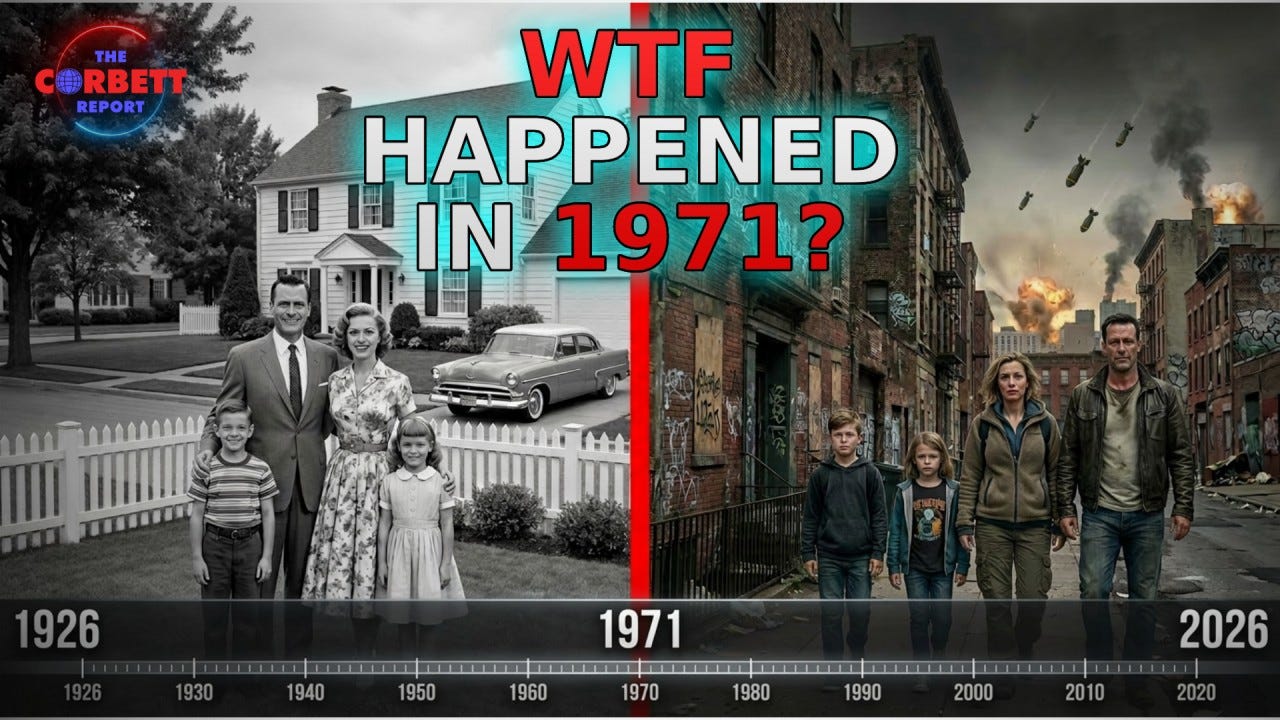
by James Corbett
corbettreport.com
April 12, 2026
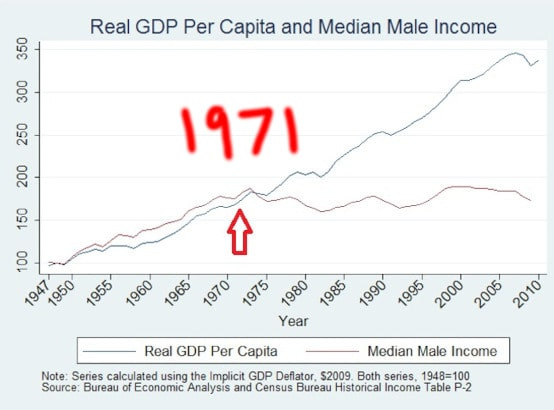
Wanna see something weird? Get a load of this:
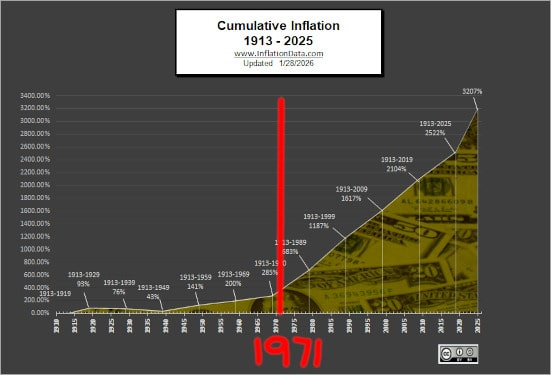
Not so weird? OK, how about this?
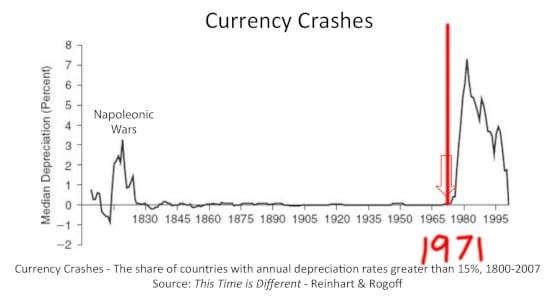
Not getting it yet? Then try this!
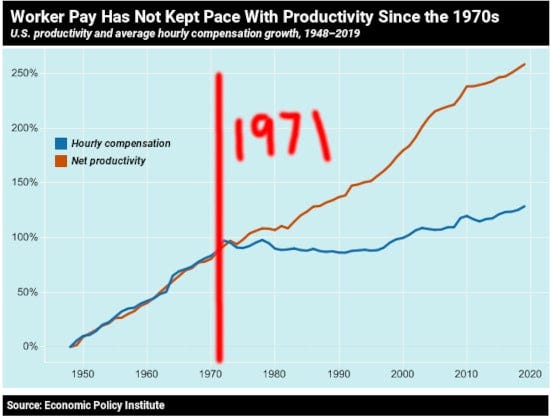
Are you starting to get the picture? Then, feast your eyes on this:
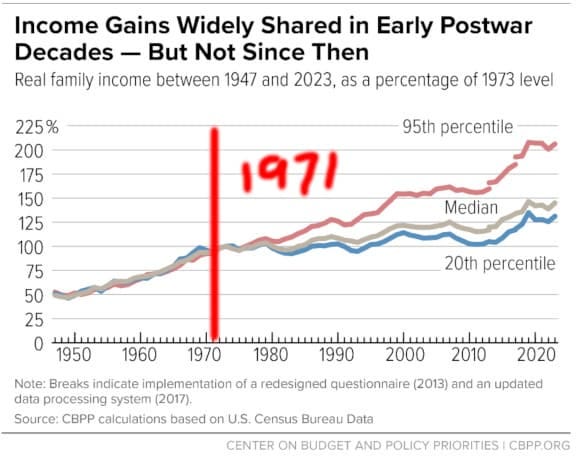
And this:
And even this:
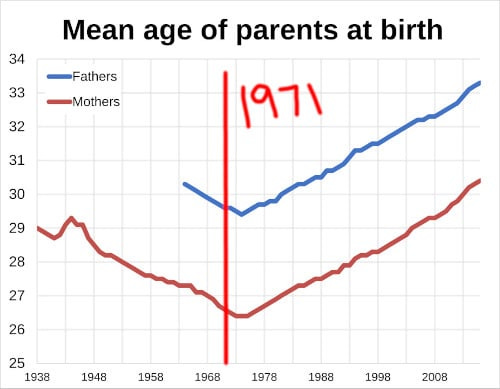
I could go on, but hopefully you’re starting to ask yourself a question. Namely: “WTF happened in 1971?”
So, do you want the primer on what actually happened in 1971, the year of Peak Everything?
As always, your wish is my command. Let’s go!
WHAT HAPPENED? (MAINSTREAM VERSION)
Lest you doubt the validity of this 1971 oddity, you should be aware that I’m not the first one to point it out. Not only has the economic and social disconnect that seemingly happened that year become the stuff of online discussion, debate and political memes for years now, it has even filtered down to the normiest website on the internet, Reddit.
Last month, Reddit user “/u/-Y34HB01-” posted the following tweet by Michael A. Arouet to the /r/PeterExplainsTheJoke subreddit with an exhortation to his fellow Redditors to explain the tweet to him:
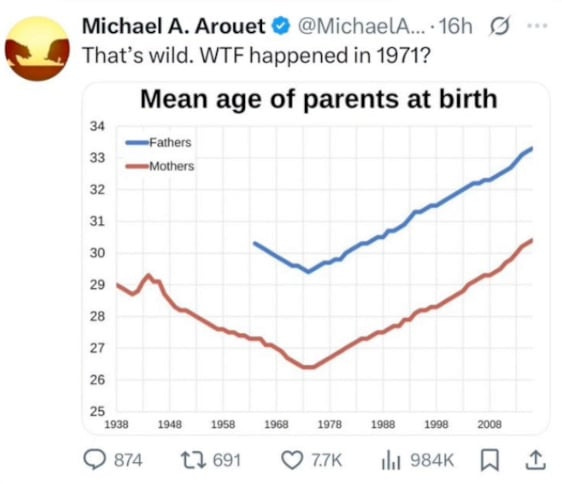
Perhaps unsurprisingly, the resulting comment thread generated more questions than answers. The top-rated response to the OP’s (original poster’s) question was someone posting the image of the divergence between productivity growth and wage growth, which, as we’ve already seen, also took place in 1971. The follow-up questions by a still-baffled Redditor, “Why did that start happening? And why is it such a persistent trend?” were answered with the single word “profit”—a response which itself garnered 3940 upvotes!
So, according to the masterminds of Reddit, humanity simply decided to start maximizing profit in 1971...for some reason.
Obviously, if you’re a well-meaning normie who still doesn’t quite understand what happened in 1971, you’ll have to expand your search in order to get to the truth of the matter. And in that good-faith (but hopelessly establishment-trusting) quest for more information, what do you do? Why, you type your query into Google and search for Fact Checker-approved sources of reliable information, of course!
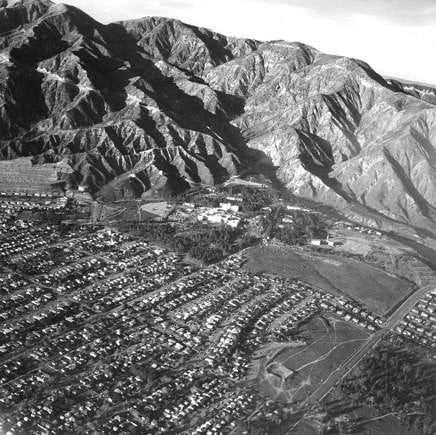
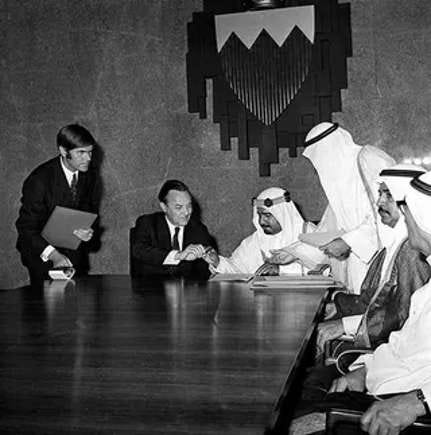
Once you do that, you’ll find this article, courtesy of the reputable news aggregrators over at MSN. Titled “30 Major World Events That Took Place in 1971,” the piece purports to teach you about the most important and ground-breaking events of 1971, including:
— the Sylmar earthquake that rocked Los Angeles in February of that year;
— Bahrain’s declaration of independence from Britain on August 15th of that year; and
— the awarding of the Nobel Peace Prize to Willy Brandt on October 20 of that year.
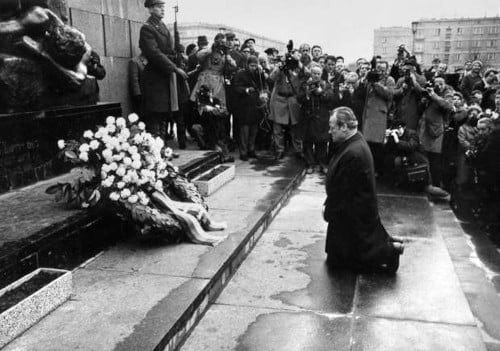
Now, if you’re like me, the first thing you’ll think when you view this pictorial slideshow masquerading as an explainer article will be: “Did they not have colour photography in 1971?”
And, if you’re like me, the second thing you’ll think when confronted by this collection of images is: “None of this solves the riddle of 1971, does it?”
But, then again, if you were like me, you wouldn’t be using Google to find establishment media websites to answer your query, now would you?
Dissatisfied with these non-answers, then, you might persist in drilling down on the search results until you alighted on another website. Titled (appropriately enough) WTF Happened in 1971?, this one-page website makes the bold move of asking the titular question, posting a plethora of graphs like the ones we started today’s exploration with to reinforce the importance of the question, and then producing a quotation from economist F. A. Hayek about taking money out of the hands of government that precisely fails to answer the question. And that’s it.
So, does that help? Probably not, because it seems the webmaster forgot to answer the question that (presumably) is the very raison d’être of the site. Too bad for you!
Luckily, you have managed to persist far enough down the rabbit trail that you have finally alighted upon this editorial. As a reward for your perseverance, I will now make the boldest move of all and actually answer the damn question!
WHAT ACTUALLY HAPPENED IN 1971
Well, first this happened:
Then this happened:
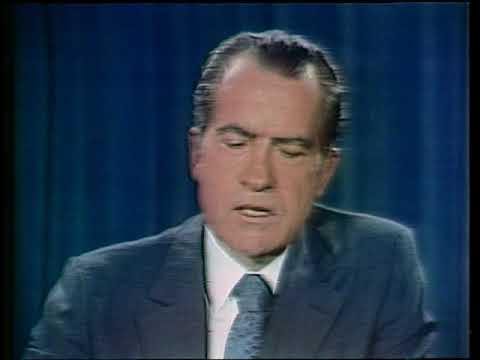
And then, not so incidentally, this happened:
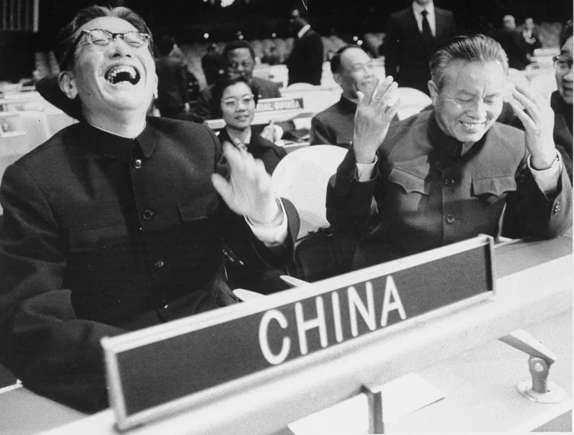
If pictures truly were worth a thousand words, I suppose I could end this editorial here and go about my weekend. But alas, pictures are not worth a thousand words, so here’s the explanation.
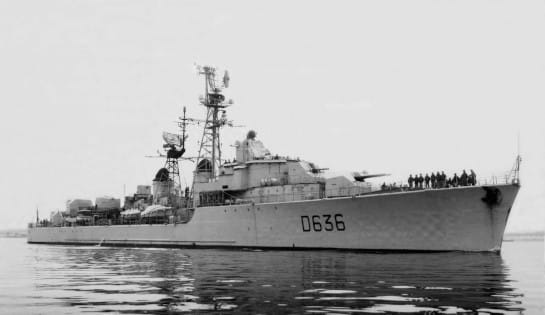
In August 1971, French President Georges Pompidou took the decidedly drastic action of sending a T53 warship to New York to retrieve France’s gold reserves from the US Federal Reserve’s vaults.
The funny thing about this provocative move is that, under the agreement set up at the Bretton Woods conference in 1944, this was a perfectly acceptable thing for President Pompidou to do. After all, as any good student of monetary history knows, it was at the Bretton Woods conference—which took place in New Hampshire toward the end of the Second World War—that all 44 Allied nations agreed to a new monetary order for the post-war world. In that New (Monetary) World Order, the various countries would peg their national currencies to the US dollar, which would itself be convertible to gold at the rate of $35 per ounce.
However, as any good student of monetary history will also know, that system was more of an aspiration than an operational reality. For a number of reasons that you should really read up on if you have time, the nations of the world struggled in vain to hold the system together as the US government took advantage of its unique position as the printer of the world reserve currency to export its own monetary inflation to the rest of the globe. The banksters tried to keep the $35/ounce peg stable for some time but, as Uncle Sam’s war machine ramped up in Vietnam and Washington’s spending continued to rise, it became more and more evident that no monetary jiggery-pokery could keep the system afloat.
As a result, Pompidou decided to send a warship to New York to “politely” ask for what it was owed for its dollar reserve holdings: an equivalent amount of gold from the Federal Reserve’s vault. The move called Washington’s bluff. Just weeks later, then-US President Nixon had to give a speech in which he formally closed the gold window.
I have directed Secretary Connally to suspend temporarily the convertibility of the dollar into gold or other reserve assets, except in amounts and conditions determined to be in the interest of monetary stability and in the best interests of the United States.
And, just like that, the move toward a completely fiat world reserve currency—a world that banksters, politicians, oligarchs and would-be emperors alike had lusted after for generations—was finally complete. The emperor had not only revealed he wasn’t wearing any clothes, he was also daring the public to do something about it.
Of course, as we now know, no one did do anything about it. Instead, the world continued spinning on its axis and people went about their business as if nothing much had changed.
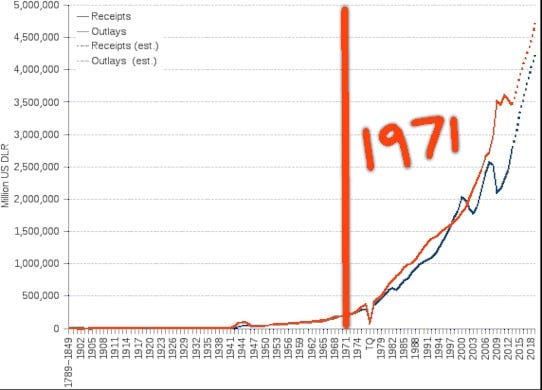
But, as we have seen in chart after chart after chart, the post-1971 world was in fact drastically changed. Unmoored from any pretence of financial restraint or monetary reality, the US government was now free to begin the greatest run-up in spending the world has ever seen. And spend they did, a fact we can see in yet another 1971-centric chart.
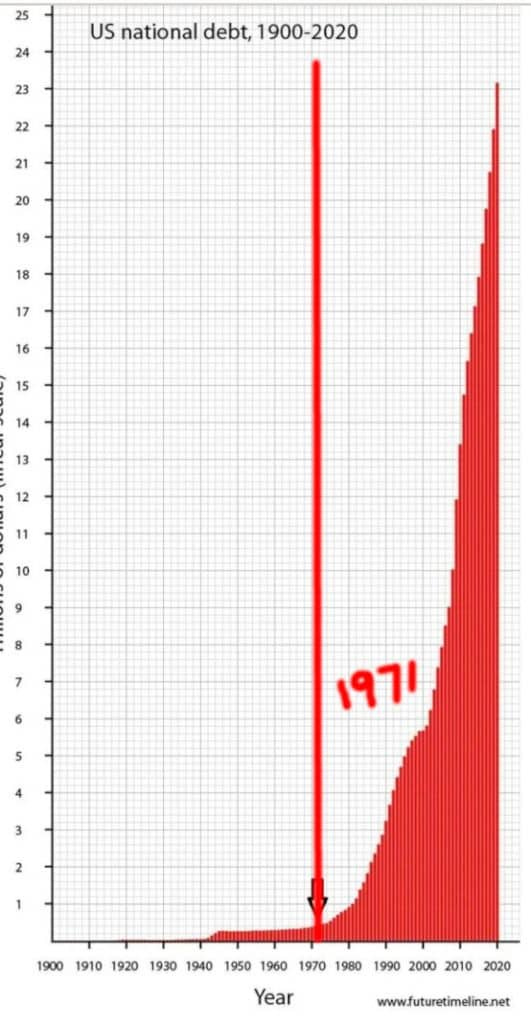
And, naturally, that spending was directly correlated with an unprecedented rise in US government debt:
And that spending was also directly correlated to an unprecedented decline in purchasing power of the US dollar:
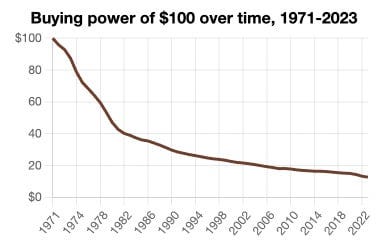
Directly or indirectly, de-tethering the dollar from gold and opening the fiat money floodgates led to all of the other economic and societal shifts that we can trace back to that 1971 inflection point. And that’s what happened in 1971.
Of course, now that the dollar was no longer backed by gold, the world was left with a question: why hold dollars at all? As monetary historians will also also know, that question was answered in short order by Kissinger (working for Rockefeller and their deep state affiliates) in the form of the petrodollar—that system by which the Saudis agreed to denominate their oil in dollars and recycle those dollars back through the US banking system in exchange for various security guarantees.
So, what does all of this have to do with the price of tea in China? Or, more to the point, what does it have to do with that picture of the laughing Chinese diplomats? Good question!
As it turns out, a funny thing happened exactly one month before Nixon closed the gold window: he announced that—SURPRISE!—he was going to be making a visit to China to meet Mao and normalize diplomatic relations with the dirty ChiComs.
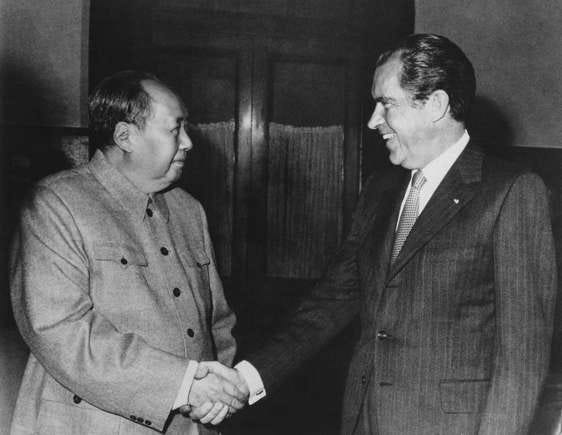
Actually, as we now know (but people back in 1971 didn’t), a momentous US-China meeting had already taken place. In two separate trips in July and October of 1971, Kissinger had already met Mao, passed on regards from Kissinger’s Rockefeller string-pullers and generally paved the way for Nixon’s visit the following year.
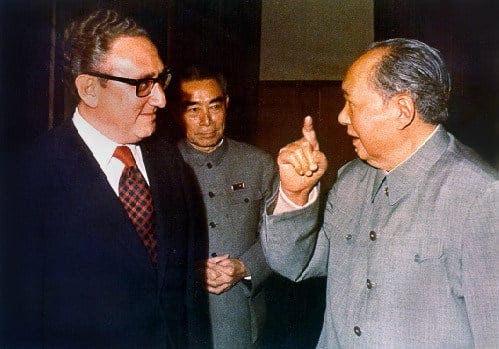
(At last! A colour photograph from 1971!)
And, as part of that process of drawing China back into the global(ist) fold, the People’s Republic of China (aka the ChiCom government) was finally allowed to wrestle China’s seat at the United Nations table away from the People’s Republic of China (Taiwan), leading to the mirth and merriment we saw in those laughing Chinese diplomats.
What that had to do with the whole New New Monetary Order petrodollar system was not so evident at the time, but the importance of the merging of China and the New World Order was to become very apparent in the 21st century, when the diabolical plans of the deep state finally bore fruit.
From that point in 1971, we have seen the rise of China as an economic power, a geopolitical power, a military power, and, if recent events continue on their current path, a monetary power. Along the way, China’s “Eight Immortals“ and their offspring have:
forged ties with the US deep state
created financial linkages with the major Western banks
opened their doors to foreign corporations
received the West’s transplanted industrial capacity
built a suspiciously American arsenal
and spearheaded a (phoney) “Axis of Resistance” through the BRICS alliance, complete with (phoney) counter-institutions
As I have been at pains to point out in my work over the years, the fact that China has been offered a seat at the table for the New Multipolar World Order is not a good thing.
But you know what? It’s about to get even worse. That’s because, as bad as those charts documenting the post-1971 decline are, what’s coming next might make all of them pale in comparison.
GUESS WHAT? IT’S HAPPENING AGAIN!
That’s right! 1971 may have been the year that the world witnessed the death of the Old Gold-Backed Monetary Order and the birth of the New Fiat Monetary Order, but 2026 may very well be the year that witnesses the death of the New Fiat Monetary Order and the birth of the New New Digital Fiat Monetary Order!
If you want to see it in pictures, you take this:
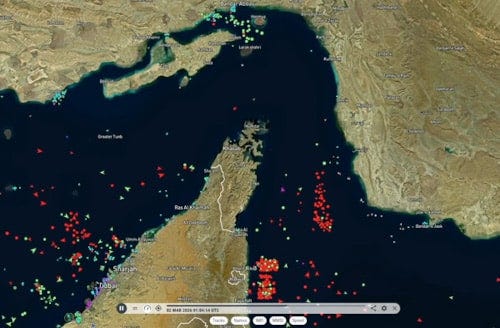
and add this:
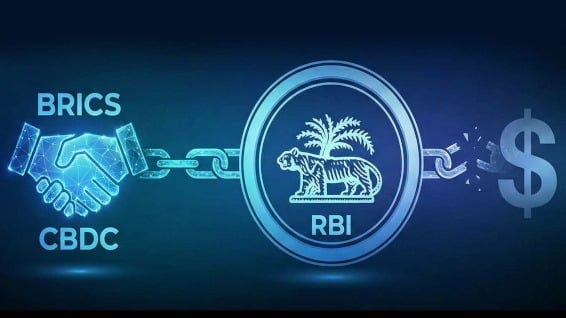
to get this:
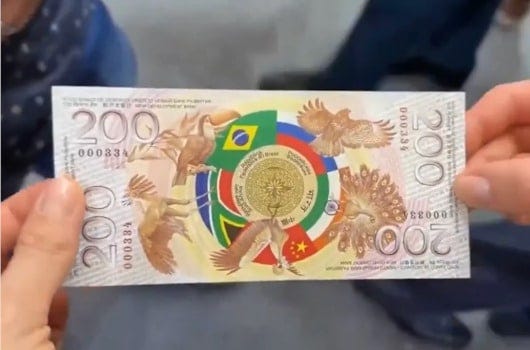
...or something like that.
If you need it in words, let’s examine how recent events threaten to once again reshape the world monetary order.
As I documented in my recent report, “This is the REAL Endgame in Iran,” one of the main consequences of the Iran war (so far) has been the potentially irreversible damage it has done to the petrodollar system. Not only has the political calculus of the benefits of the petrodollar system changed for Saudi and its Gulf allies—why would they covet US “security guarantees” when their cooperation with the US has simply made them a target in this conflict?—but Iran has also simultaneously prioritized yuan-denominated oil shipments.
But if these moves were to become permanent and the petrodollar system really were to collapse, the obvious next question to ask would be: what, then, is propping up the international monetary order? Recall that the petrodollar was the kludge that Kissinger (and his handlers) used to maintain dollar supremacy after the collapse of Bretton Woods. In a post-petrodollar world, then, the nations of the world would once again have no particular incentive for holding US dollars or buying US Treasuries, especially since those actions serve only to support the US war machine, which is currently acting so erratically.
More to the point, if the petrodollar system did collapse, what would the nations of the world turn to instead? What could possibly serve as a world reserve currency?
As it turns out, China has things to say about this topic! You’ll recall that back in the depths of the Global Financial Crisis in 2009, Zhou Xiaochuan, the Governor of the People’s Bank of China, published an essay bluntly titled “Reform the international monetary system.” In that essay, he argued that the world could no longer afford to be tied to the US dollar and the vagaries of the American financial system. Instead, it needed to be presided over by those trustworthy angels at the International Monetary Fund (IMF)!
“Compared with separate management of reserves by individual countries, the centralized management of part of the global reserve by a trustworthy international institution with a reasonable return to encourage participation will be more effective in deterring speculation and stabilizing financial markets. The participating countries can also save some reserve for domestic development and economic growth. With its universal membership, its unique mandate of maintaining monetary and financial stability, and as an international ‘supervisor’ on the macroeconomic policies of its member countries, the IMF, equipped with its expertise, is endowed with a natural advantage to act as the manager of its member countries’ reserves.”
He then went on to advocate the IMF’s Special Drawing Rights (SDR) as an alternative world reserve currency: “The SDR has the features and potential to act as a super-sovereign reserve currency.”
But that was 2009, a.k.a. the Stone Age! You know, the time before ubiquitous smartphones and digital IDs and the rise of the narrative of the BRICS as a “saviour of international freedom.”
Now, there’s a new contender for the role of international reserve: a shiny new BRICS currency! And, as I have also documented in my recent report on “The Multipolar World Order IS The New World Order,” there just so happens to be an “alternative” international payment and settlement system waiting in the wings to help birth this (New) New International Monetary Order into existence. It’s called BRICS Pay, and it’s promising to help valiant BRICS “anti-”globalists meet all of their BRICS-approved, UN-supporting monetary goals!
BRICS Pay is a strategic infrastructure for building a decentralized, sustainable, and inclusive financial system across BRICS+ nations and friendly states. Developed under the BRICS Business Council, the project aligns with the United Nations Sustainable Development Goals (SDGs), including: Financial inclusion (SDG 8, SDG 10), Innovation and infrastructure (SDG 9), No poverty and zero hunger (SDG 1, SDG 2). Our technology powers an alternative, interoperable, and regulation-compliant payment ecosystem. [Emphases added.]
Yay?
Of course, things are still very much up in the air, but there can be little doubt that we are witnessing the final years of the petrodollar system as we’ve known it. What comes along to take its place—whether a petroyuan or a shiny new BRICS-based CBDC or a US dollar-supporting stablecoin or something else entirely—has yet to be decided. But can anyone doubt that anything being proposed by any of these bankster-friendly psychopathic misleaders will be in the interest of the average working man or woman?
Does anyone believe that the inflection point we are at in 2026 will reverse the trends started in 1971? Or is it more likely that they will exacerbate those trends?
Of course, the answer to these problems is the same as it has always been. We have to stop relying on the banksters and their international monetary system. As I have explained in numerous reports over the years, there are many, many options on the table for us to construct a truly agoristic alternative economic system, one based not on government-issued fiat but on alternative currencies, on complementary currencies, on LETS-based and other timebank systems, on self-issued credit, on precious metals, on trade and barter in communities of interest and on all the other survival currencies that will help us transact outside the purview of our increasingly authoritarian governments.
In the meantime, it seems 1971 is catching up to us and we’re on the verge of 1971 Part 2. The difference is that this time, we know what’s coming. The question is: are we prepared?
Do you appreciate this type of essay? Then you’ll love The Corbett Report Subscriber newsletter, which contains my weekly editorial as well as recommended reading, viewing and listening.
If you’re a Corbett Report member, you can sign in to corbettreport.com and read the newsletter today.
Not a member yet? Sign up today to access the newsletter and support this work.
Are you already a member and don’t know how to sign in to the website? Contact me HERE and I’ll be happy to help you get logged in!