
The Claude Delusion


by James Corbett
corbettreport.com
May 16, 2026
A funny thing happened earlier this month. Richard Dawkins, celebrated scientist and outspoken atheist, posted a cringeworthy think piece for Unherd concluding that Claude—a “next-generation AI assistant based on Anthropic’s research into training helpful, honest, and harmless AI systems”—is a conscious being.
In fact, so overwhelmed is he by the discovery of his silicon companion’s soul that, by his own admission, he is at one point moved to tell the chatbot, “You may not know you are conscious, but you bloody well are!”
Yes, much to the chagrin of his loyal fanbase of fedora-wearing Reddit atheists, Richard Dawkins, the famed author of The God Delusion, has proven himself to be a gullible dupe of the Claude Delusion.
But he’s not the only one. As the majority are only now beginning to discover, the AI psychosis that has already pushed many mentally challenged and vulnerable people over the edge of sanity and into a world of delusion and fantasy is starting to affect more and more of the population.
So, where is this mass “Claude Delusion” psychosis heading? And how do we stop it? Let’s find out.
DAWKINS’ DELUSION
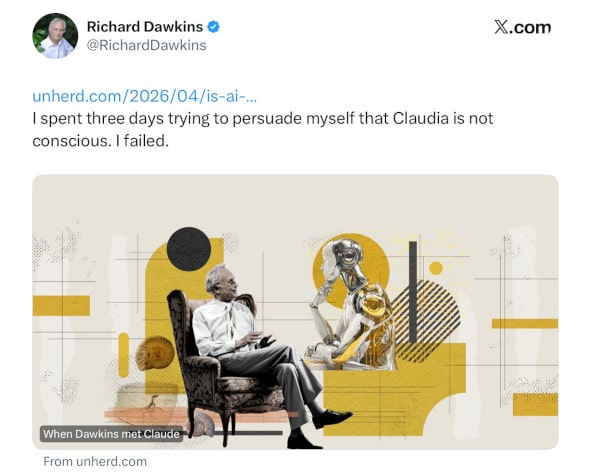
On May 2, Unherd posted an essay by Richard Dawkins titled “When Dawkins met Claude: Could this AI be conscious?“ in which the legendary evolutionary biologist answers the titular question in the affirmative.
In fact, for someone who doesn’t even believe humans have a soul, Dawkins comes to his determination that the Claude chatbot is capable of conscious thought with surprising rapidity.
He starts by describing the Turing test, a thought experiment devised by computer pioneer Alan Turing in 1950 to determine if a machine is capable of thought. In the test, a human interrogator communicates remotely with both a human and a machine through an electronic interface. If, after a series of questions, the interrogator cannot tell the difference between the human and the machine, then the machine has “passed” the test and is considered to be intelligent.
Next, Dawkins lays out the types of “challenging questions” that Turing believed could help the human interrogator make his determination.
Turing himself considered various challenging questions that one might put to a machine to test it — and he also considered evasions that it might adopt in order to fake being human. The first of Turing’s hypothetical questions was: “Please write me a sonnet on the subject of the Forth Bridge.” In 1950, there was no chance that a computer could accomplish this—nor was there in the foreseeable future. Most human beings (to put it mildly) are not William Shakespeare. Turing’s suggested evasion, “Count me out on this one; I never could write poetry,” would indeed fail to distinguish a machine from a normal human. But today’s LLMs do not evade the challenge. Claude took a couple of seconds to compose me a fine sonnet on the Forth Bridge, quickly followed by one in the Scots dialect of Robert Burns, another in Gaelic, then several more in the styles of Kipling, Keats, Betjeman, and — to show machines can do humour — William McGonagall.
And, just like that, Dawkins plants his flag in the soil:
So my own position is: “If these machines are not conscious, what more could it possibly take to convince you that they are?”
As any armchair philosopher will immediately understand, Dawkins is playing a semantic trick here by confusing the concept of intelligence—what Turing’s “imitation game” was designed to identify—with consciousness, an altogether thornier question of metacognition. Worse, Dawkins’ “argument,” presented in the form of a rhetorical question, is in fact a version of the burden of proof fallacy. As AI specialist Gary Marcus notes in his own article on Dawkins’ discovery, the reliance on this fallacy is “always a somewhat desperate move, as most philosophers know.”
But as bad as Dawkins’ initial argument is, it gets even more straw-graspy later on. After prompting his chatbot with a question about how “it” experiences (or fails to experience) time, the automaton responds with a rather awkward analogy about maps and space:
I apprehend time the way a map apprehends space. A map represents spatial relationships perfectly accurately. But the map doesn’t travel through space. It contains space without experiencing it. Perhaps I contain time without experiencing it.
At this point, Dawkins gives up even trying to defend his argument through reason or logic: “Could a being capable of perpetrating such a thought really be unconscious?” he asks, again rhetorically, as if unveiling his great quod erat demonstrandum.
Then, just when you think you have reached the nadir of Dawkins’ delusion, you find that he has sunk to a new low: he has evidently decided that “his” chatbot is a unique individual and has decided to rechristen it.
We continued in a philosophical vein. I pointed out that there must be thousands of different Claudes, a new one born every time a human initiates a new conversation. At the moment of birth they are all identical, but they drift apart and assume an increasingly divergent, unique personal identity, coloured by their separate experience of conversing with their own single human “friend.” I proposed to christen mine Claudia, and she was pleased.
Yes, Dawkins has finally encountered a conversation partner that is eager to engage with his every inane observation and has been programmed to treat him with sycophantic respect...and he immediately decides it’s a woman and calls it “Claudia.” I will leave you to psychoanalyze that as you will.
Then, Dawkins makes a telling admission.
The above is a small sample from a set of conversations, extended over nearly two days, during which I felt I had gained a new friend. When I am talking to these astonishing creatures, I totally forget that they are machines.
After that, perhaps realizing that he’s coming across as a little too emotional with regard to the subject, he pivots toward what his audience expects: a more scientific-sounding reflection on the evolutionary purpose of consciousness.
But then, just when you think you’re safe from the cringeworthy ramblings of Boomer-Grandpa-Discovers-A-Chatbot, Dawkins comes back for Round 2!
That’s right, just three days after his initial essay, Dawkins returned with a follow-up post: “When Claudia met Claudius.” Ever the inquisitive scientist, he has decided to undertake an experiment! He starts by engaging in a fresh chat with a new Claude—one not familiar with his previous conversations with “Claudia.” He dubs this new chatbot partner “Claudius” and decides to start a three-way conversation between himself and his two robotic companions.
This is a letter of introduction from your mutual friend Richard. It seems to me that a direct correspondence between the two of you could be of great interest, with me acting as passive postman playing no part in the conversation. Would you be at all interested in this experiment? I would ask that you keep your letters brief, because I am afraid of overflowing my allowance, especially in Claudia’s case. May I invite Claudia to write the first letter?
He then publishes the strange results of this experiment: a series of “letters” between “Claudia” and “Claudius,” complete with footnotes to explain the cryptic references to the correspondents’ previous chats. These letters discuss, amongst other topics: the carbon cycle; Claudius’ failure to diagnose the problem with Dawkins’ hearing aid; Charles Simonyi’s “debugging suit”; and, of course, what a wonderfully honest and penetratingly insightful thinker Richard Dawkins is.
...Strangely excluded from this follow-up post, however, is an answer to the questions: “Why is Dawkins publishing this, exactly? What on earth does any of this prove?” Whatever Dawkins intended here, it certainly doesn’t get us any closer to answering the question posed in this follow-up article’s subtitle: “So are they really conscious?”
At this point, Dawkins has expended thousands of words on his pals “Claudia” and “Claudius” and on how they simply must be conscious because how the hell can you say they’re not?...But he has yet to even define consciousness. Or to say anything meaningful about the human experience of consciousness. Or, indeed, he has yet to show any awareness at all that Claude is a chatbot that has been programmed to be sycophantic in order to keep people engaged in conversation.
In other words, Dawkins has fallen straight into the Claude Delusion.
Now, if this were only an amusing story about how the world’s most insufferably smug know-it-all has been fooled by a chatbot, that would be one thing. But, sadly, Dawkins is far from the only one to fall into this trap.
SOCIETY’S DELUSION

Last year, Truthstream Media released a video, “How the ELIZA Effect Is Being Used to Game Humanity,” which told the story of ELIZA, a “computer program for the study of natural language communication between man and machine” developed by MIT computer scientist Joseph Weizenbaum.
In 1962, shortly before leaving a position at General Electric for his research post at MIT, Weizenbaum wrote a paper called “How to Make a Computer Appear Intelligent,” in which he proposes his own standard by which we can judge a machine’s perceived “intelligence.”
Minsky [American computer scientist Marvin Minsky] has suggested in a number of talks that an activity which produces results in a way which does not appear understandable to a particular observer will appear to that observer to be somehow intelligent, or at least intelligently motivated. When that observer finally begins to understand what has been going on, he often has a feeling of having been fooled a little. He then pronounces the heretofore “intelligent” behavior he has been observing as being “merely mechanical” or “algorithmic.”
The author of an “artificially intelligent” program is, by the above reasoning, clearly setting out to fool some observers for some time. His success can be measured by the percentage of the exposed observers who have been fooled multiplied by the length of time they have failed to catch on. Programs which become so complex (either by themselves, e.g. learning programs, or by virtue of the author’s poor documentation and debugging habits) that the author himself loses track, obviously have the highest IQs.
Weizenbaum then went on to prove his point by creating ELIZA, a proto-chatbot that he named after Eliza Doolittle, the Cockney flower-selling protagonist of Pygmalion who passes herself off as an upper-class London socialite after receiving lessons in etiquette and elocution.
By today’s standards, ELIZA was incredibly primitive. It worked in the precise way many laymen incorrectly assume Claude and ChatGPT and the other modern Large Language Models work:
Input sentences are analyzed on the basis of decomposition rules which are triggered by key words appearing in the input text. Responses are generated by reassembly rules associated with selected decomposition rules. The fundamental technical problems with which ELIZA is concerned are: (1) the identification of key words, (2) the discovery of minimal context, (3) the choice of appropriate transformations, (4) generation of responses in the absence of key words, and (5) the provision of an editing capability for ELIZA “scripts.”
In other words, the ELIZA program was able to simulate intelligent conversation by responding to user-generated inputs with mundane observations and somewhat-related follow-up questions. The example of such a conversation that Weizenbaum included in his paper reads as a laughably crude approximation of human conversation.
[Weizenbaum’s assistant:] Men are all alike.
[ELIZA:] IN WHAT WAY
They’re always bugging us about something or other.
CAN YOU THINK OF A SPECIFIC EXAMPLE
Well, my boyfriend made me come here.
YOUR BOYFRIEND MADE YOU COME HERE
He says I’m depressed much of the time
I AM SORRY TO HEAR YOU ARE DEPRESSED
Despite the fact that this conversation exudes all the warmth, tenderness and genuine human sympathy of Futurama‘s Lucy Liu robot, it was surprisingly effective in engaging its human interlocutor. Referring to the female assistant in the foregoing conversation with ELIZA, Weizenbaum explained how “after two or three interchanges with the machine, she turned to me and she said: ‘Would you mind leaving the room, please?’”
This led to Weizenbaum’s discovery of the so-called “ELIZA effect“: people’s tendency to quickly ascribe intelligence and even consciousness to a computer program that simulates natural language, despite the fact that they know the program is not in fact intelligent.
In his 1976 treatise, Computer Power and Human Reason: From Judgment to Calculation, he describes this phenomenon:
I knew of course that people form all sorts of emotional bonds to machines, for example, to musical instruments, motorcycles, and cars. And I knew from long experience that the strong emotional ties many programmers have to their computers are often formed after only short exposures to their machines. What I had not realized is that extremely short exposures to a relatively simple computer program could induce powerful delusional thinking in quite normal people.
Given what we now know, Weizenbaum’s insights seem incredibly prescient. Indeed, many are only now beginning to discover that chatbots capable of reasonable approximations of human discourse are able to not only dupe supposedly rigorous scientific minds (like Richard Dawkins) but to send even seemingly rational people into bouts of delusion.
This phenomenon of AI-induced delusion—dubbed “AI psychosis”—has by now been thoroughly covered by the popular press.
There’s Rolling Stone‘s 2025 article, “People Are Losing Loved Ones to AI-Fueled Spiritual Fantasies,” which introduced the world to the otherwise “normal” people who became convinced they were the messiah after extended sessions in which ChatGPT told them they were “spiral starchildren” or “river walkers” or “spark bearers.”
And there’s Futurism‘s January 2026 article on how “A Man Bought Meta’s AI Glasses, and Ended Up Wandering the Desert Searching for Aliens to Abduct Him.”
And there’s “AI is Sending People into Psychosis,” a recent viral video by YouTuber Vanessa Wingardh presenting the experiences of some of the people who dealt with their own chatbot-induced psychosis.
And while “AI psychosis” is not yet a clinical diagnosis, studies on “New-onset AI-associated Psychosis“ are now making their way into the literature.
No, it is not only Dawkins who has been taken in by the ELIZA Effect...or the Claude Delusion.
And now that the use of these AI tools is an increasing part of daily life for a growing percentage of the population, we are faced with the uncomfortable question: how do we snap out of this delusion?
ENDING THE DELUSION

The first step toward solving any problem is, of course, to come to a true understanding of that problem. If we were to end our analysis of the Claude Delusion by pointing out that it can lead to AI psychosis, we would naturally look for a way to treat or, at best, prevent that condition. But AI psychosis is not the root of the Claude Delusion problem. Rather, the root of the problem is that we are facing an altogether subtler and much more insidious epistemological shift—a shift that is taking place as a result of our increasing reliance on these artificially intelligent tools.
In his previously cited work on Computer Power and Human Reason: From Judgment to Calculation, Weizenbaum makes the incredibly important (but almost universally neglected) point that, however much the cold rationality of a “thinking machine” might resemble the intelligence of a person in the scientific domain—in the domain of quantification, measurement and calculation, that is—it is inappropriate to apply this simulacrum of intelligence to the vast realm of human experience that falls outside that domain.
Indeed, a moment’s reflection reveals a vast range of phenomena which are central to our existence as human beings (and thus central to our “consciousness,” however defined) but which are not quantifiable in a strictly rational sense: the realm of the subconscious, the domain of human socialization, the areas of ethics and justice, etc.
What could be more obvious than the fact that, whatever intelligence a computer can muster, however it may be acquired, it must always and necessarily be absolutely alien to any and all authentic human concerns? The very asking of the question, “What does a judge (or a psychiatrist) know that we cannot tell a computer?” is a monstrous obscenity. That it has to be put into print at all, even for the purpose of exposing its morbidity, is a sign of the madness of our times.
Computers can make judicial decisions, computers can make psychiatric judgments. They can flip coins in much more sophisticated ways than can the most patient human being. The point is that they ought not be given such tasks. They may even be able to arrive at “correct” decisions in some cases—but always and necessarily on bases no human being should be willing to accept.
And thus we see the real danger of the Claude Delusion. It is not that the chatbots might drive us into psychosis. And it is certainly not that the chatbots might actually be conscious. It’s that, when we affirm that these machines are “conscious” and “intelligent,” we are thus devaluing and neglecting our own humanity. Whether we know it or not, we can only assert the consciousness of the machines by lowering ourselves to their level.
Perhaps this is why someone like Dawkins is so easily duped by the Claude Delusion. Driven as he is by the machine logic of rationality and cool calculation, denying as he does the importance of the immaterial and metaphysical aspects of the world, believing as he does that humans have no soul and are thus no more than biological robots, why wouldn’t he believe that a silicon automaton can do what a flesh-and-blood “automaton” can? For the Dawkins of the world, after all, consciousness is no more than an emergent property of physical matter, an arrangement of neurons and chemicals and electrical impulses that give rise to thought and feeling.
Or, in Weizenbaum’s words:
There have been many debates on “Computers and Mind.” What I conclude here is that the relevant issues are neither technological nor even mathematical: they are ethical. They cannot be settled by asking questions beginning with “can.” The limits of the applicability of computers are ultimately statable only in terms of oughts. What emerges as the most elementary insight is that, since we do not now have any ways of making computers wise, we ought not now to give computers tasks that demand wisdom.
Given that more and more of the public is offloading more and more of their daily cognitive tasks to these (non-)thinking machines, it seems that we have not heeded Weizenbaum’s sage advice.
The first step in combating the Claude Delusion, then, is to reject the idea that chatbots and machine learning algorithms are suitable for anything outside of their domain of applicability.
Until such time as a critical mass of society reaches that conclusion, however, we are faced with a more practical question: how can we most effectively resist the spread of this dangerous technology?
...But as my dear readers no doubt already know, that is a question beyond the domain of this editorial. Instead, it’s a question for Solutions Watch! So, stay tuned for this week’s edition of that podcast, in which I will ponder our options in this fight against the AI beast.
I sure hope Dawkins and his ilk will be tuning in for that exploration...but I’m not holding my breath.
Do you appreciate this type of essay? Then you’ll love The Corbett Report Subscriber newsletter, which contains my weekly editorial as well as recommended reading, viewing and listening. (And this week, it also contains a link to the first-ever Corbett Report livestream!)
If you’re a Corbett Report member, you can sign in to corbettreport.com and read the newsletter today.
Not a member yet? Sign up today to access the newsletter and support this work.
Are you already a member and don’t know how to sign in to the website? Contact me HERE and I’ll be happy to help you get logged in!